Ask most people whether a personal trainer is worth it, and the instinctive answer arrives as a question about price: how much per session, how many sessions, what the monthly figure comes to. It is the wrong first question. Not because money is irrelevant — in Dubai, where the market runs from budget freelancers to premium coaching, it clearly matters — but because price is only one side of a ledger most people never finish reading.
The other side is what it costs to keep not getting there. The gym membership paid for and barely used. The eighteen months of training that never quite moved the needle. The recurring January restart, a little more discouraged each time. For a great many people, the real expense of their fitness is not the coach they didn't hire; it is the years they spent without one.
This article looks at both sides of that ledger honestly. It is written for the reader genuinely weighing the decision — comparing a gym membership against personal training, wondering whether coaching is a luxury or an investment, and, above all, trying to work out what actually determines results. The aim is not to talk you into hiring anyone. It is to help you decide well, whichever way you land.
Key takeawayWhether a personal trainer is worth it is the wrong question to start with price. The real comparison is the cost of coaching against the cost of not getting there — the memberships barely used and the months of training that never moved the needle. Worth is about outcomes, not the per-session figure.
Why Most People Struggle to Reach Their Fitness Goals Alone
If effort alone produced results, most people would already have them. The gyms of DIFC and Dubai Marina are full of committed, intelligent professionals who work hard and still stall. The problem is almost never willpower. It is the absence of the things willpower cannot supply.
The first is structure. Training without a plan is just activity, and activity repeated without progression plateaus quickly. The body adapts to what it already does; without a deliberate increase in load, volume or difficulty over time, it has no reason to keep changing.
The second is consistency, and here Dubai's rhythm works against people. Long hours, frequent travel and an unpredictable calendar mean the self-made plan that looked sensible on Sunday is in pieces by Wednesday. Sporadic effort, however intense, rarely compounds into anything.
Then come the quieter failures. Poor exercise selection — hours spent on movements that flatter the ego rather than build the body. Technique that quietly invites injury. Nutrition decisions made on guesswork or the latest trend. And the sheer information overload of modern fitness, where every voice contradicts the last and the honest answer, “it depends on you,” is the one nobody is selling.
Underneath all of it sits the most underrated factor of all: accountability. Training alone, the only person you answer to is yourself — on precisely the days you least feel like it. That is usually when the plan quietly ends.
What Does a Personal Trainer Actually Do?
The common assumption is that a personal trainer — or fitness coach — counts your repetitions and keeps you company. A good one does something far more valuable: they remove the guesswork that causes most people to fail.
It begins with assessment. Before any programme is written, a professional looks at how you move, your history, your injuries, your lifestyle and your actual goal — because a plan built on a proper baseline is a different thing entirely from a template pulled off a shelf.
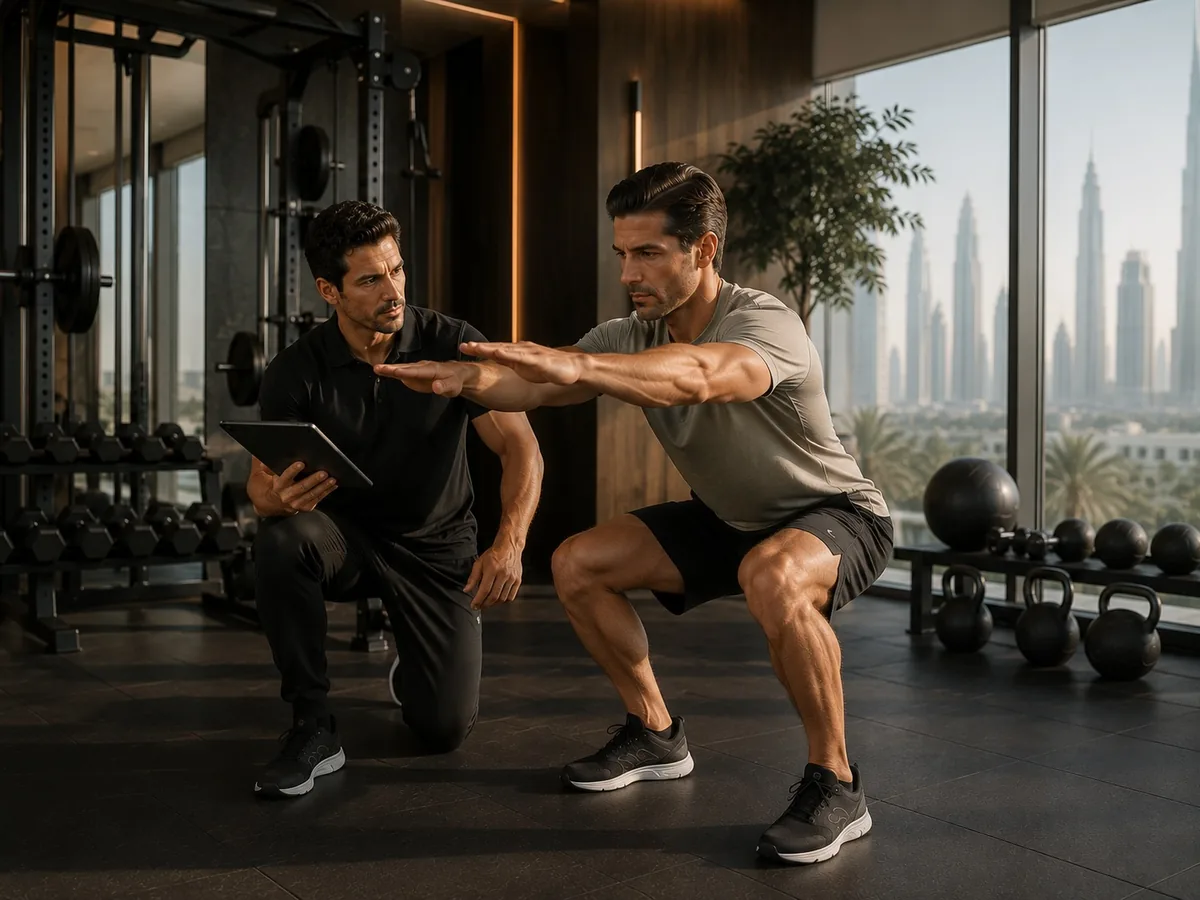
From there comes programme design: the right exercises, in the right order, at the right intensity, progressed deliberately over weeks and months so the body keeps adapting instead of stalling. Technique is corrected in real time, which both accelerates results and prevents the injuries that send self-trainers back to the start.
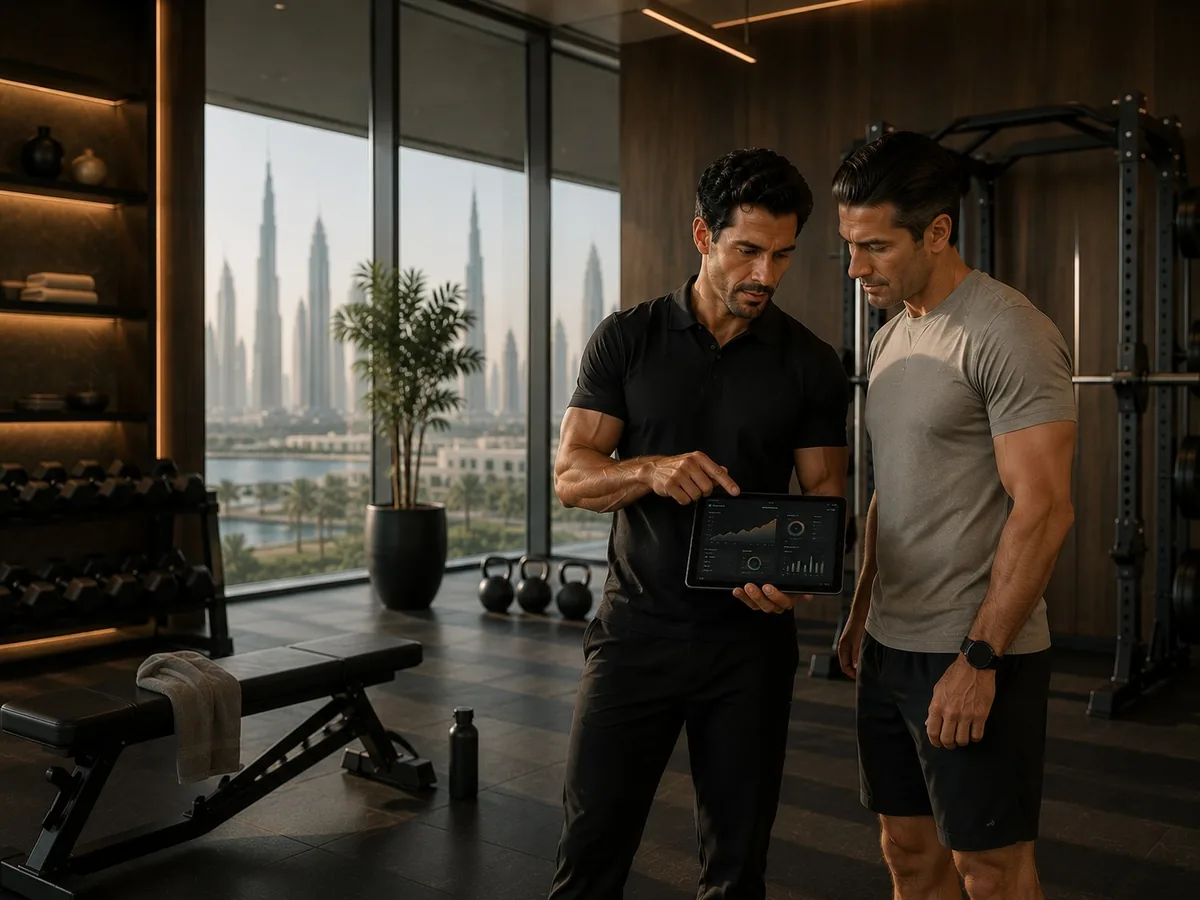
Progress is tracked against clear markers rather than mood or mirror, so decisions rest on evidence. The programme is adapted as your body, your schedule and your results change — the part most apps and templates simply cannot do. There is genuine accountability, the fixed point that keeps the work happening through a demanding quarter. And there is informed guidance on nutrition and recovery, within a coach's proper scope, because what happens in the many hours outside the session decides most of the outcome.
None of this is motivation in the cheerleading sense. It is judgement, applied to your specific situation, week after week. That judgement is what you are actually paying for.
The Real Cost of Not Hiring a Trainer
Here is where the ledger gets interesting. The cost of a trainer is visible and easy to tally. The cost of going without one is larger, but hidden — which is exactly why it is so often ignored.
Consider what an unproductive year actually contains. A membership paid every month and used a fraction of the time. Supplements bought on hope rather than need. A diet started, abandoned and restarted more than once. Perhaps a strain or a niggle from a movement performed slightly wrong for months. And, running underneath it all, the slow erosion of belief that any of this will ever work for you.
Add those together and the “expensive” option often turns out to be the cheaper one. But the financial figure is not even the main cost. The real expense is opportunity — the year of health, energy and confidence that a structured approach would have moved forward, spent instead standing still. You cannot buy that time back at any price.
This is the reframing that matters. The question is not “can I afford a trainer?” It is “what is another year of no progress actually worth to me?” For most people weighing the decision seriously, that second figure is far larger than the first.
Personal Trainer Cost in Dubai: What Should You Expect?
Dubai prices personal training across an unusually wide range, and it helps to understand why before judging any single quote. For the specific figures, our dedicated guide on what personal training costs in Dubai breaks the ranges down; this section is about how to read them.
Price tracks a handful of real variables. Experience and a documented record of results command more than a newly qualified trainer, and reasonably so — you are paying for the years of pattern recognition that solve your problem faster. A private studio or in-home service carries a premium over a crowded commercial gym floor, because time, discretion and environment have value. Genuine customisation — a programme built for you and adjusted continuously — costs more than a recycled template. So does availability at the hours a busy professional can actually train.
The mistake is to shop on price alone. The cheapest session is rarely the cheapest result, because results depend on the coaching, not the hour. A low rate that produces nothing over three months is not a saving; it is the most expensive option available, having cost you both the money and the time. Judge value — what will reliably get you the outcome — rather than the headline number. The right question is never “what is cheapest?” but “what is this worth to me if it works?”
When Hiring a Personal Trainer Is Worth It
For most people with a specific goal and limited time, the honest answer is yes — and a few situations make the case especially clearly.
If your goal is fat loss, a good weight loss coach protects muscle while you are in a deficit and keeps nutrition and training aligned: the difference between a genuine change in body composition and simply becoming a smaller version of the same shape. If it is muscle or strength, a strength coach's structured progressive overload and correct technique are precisely what most self-trainers get wrong.
Time-pressed executives benefit disproportionately: when hours are scarce, the efficiency of a well-designed session and the accountability of a fixed appointment are worth more, not less. Anyone recovering from or training around an injury needs qualified eyes to avoid making it worse. Beginners gain the most of all — building correct habits from the start saves years of undoing bad ones later. Older adults, for whom technique, joint health and muscle preservation carry higher stakes, are both safer and faster with guidance. And for anyone pursuing a real, lasting change of lifestyle rather than a short, punishing push, a coach is what turns intention into a system that survives real life. A deadline such as a wedding simply compresses all of this into sharper focus.
The common thread is not the goal. It is whether the cost of getting it wrong — in time, in setbacks, in another false start — is high enough that expert guidance pays for itself. For the people above, it usually does.
When You May Not Need One
Credibility runs both ways, so here is the honest other side: not everyone needs a personal trainer, at least not continuously.
If you already train consistently, understand programming, execute the main lifts well and are genuinely progressing on your own, you may not need ongoing coaching — you have effectively already built the system a trainer would provide. Some people are internally accountable enough that consistency is simply not their failure point, and for them a coach adds refinement rather than transformation.
Others are well served by a lighter touch: a short block of coaching to learn technique and set up a proper plan, then a stretch of training independently, checking back in when they plateau or their goal changes. And for the disciplined traveller who already knows their way around a gym, a structured online performance coaching arrangement can deliver most of the benefit without in-person sessions.
The point is not that everyone should hire a coach. It is that you should know which kind of person you are — because matching the level of support to your actual gap is what makes the spend intelligent rather than automatic.
How to Choose the Right Personal Trainer in Dubai
If you decide coaching is worth it, choosing well matters as much as the decision itself. Certifications are a baseline, not a differentiator — assume any credible trainer holds them, and look further. Our companion guide on how to choose the right personal trainer in Dubai covers this in depth; here is the short version.
Look for relevant experience — someone who has coached people at your stage and towards your goal, not simply years in the abstract. Ask how they assess a new client: a real assessment before any programme is written is the clearest single sign of a professional. Ask how they track progress and how often they review it, because coaching should answer to data, not mood. Ask how they individualise — a plan that would be identical for the next client is not personal training.
Beyond method, weigh the human factors: communication you trust, evident professionalism, and the ability to think in terms of long-term planning rather than a single transformation. Where you can, look at results with people like you — the only results that reliably predict your own. You can usually get a clear read on all of this in one honest conversation, long before any commitment.
Frequently Asked Questions
Is a personal trainer worth the money?
For most people with a real goal and limited time, yes — but the honest test is comparative. Weigh the cost of coaching against the cost of another year without progress: the wasted membership, the false starts, the lost time. When the second number is larger, coaching is an investment rather than an expense.
How long should I work with a personal trainer?
It depends on your starting point and goal. Some people work with a coach continuously because accountability is their gap; others use a focused block to learn technique and build a plan, then train independently and return when they plateau. The aim is to build a system you can sustain, not a permanent dependency.
Can beginners really benefit from a personal trainer?
Beginners arguably benefit most. Building correct technique and habits from the start prevents years of undoing bad ones, avoids early injuries, and means the foundational period — where progress is fastest — is not wasted on guesswork.
How quickly can I expect results?
With consistent training and sensible nutrition, most people notice improvements in energy and strength within a few weeks and clearer physical changes within roughly two to three months. Anyone guaranteeing dramatic results faster than that is overselling; honest coaching sets realistic expectations.
Is online coaching enough, or do I need in-person sessions?
For a disciplined, reasonably experienced person, structured online coaching delivers most of the benefit — programming, progression and accountability — with more flexibility. Beginners and those training around an injury usually benefit from in-person guidance, at least to begin with.
Is personal training a luxury or an investment?
It is a luxury only when bought without a plan — sessions purchased in isolation, with no system behind them. Bought as the mechanism that reliably produces a result you value, after months or years of it not happening, it is an investment, and often a shrewd one.
How is a personal trainer different from a gym membership?
A membership buys access to equipment; a coach buys a system — assessment, structure, correct execution, measurement and accountability — applied to your specific situation. Access is what most people already have and under-use. The system is what actually produces the result.
Conclusion
So, is a personal trainer worth it? The honest answer is that the sessions, in themselves, never are. What is worth it is the system they represent: assessment, structure, correct execution, measurement, accountability and continuous adaptation, applied to your life until the result actually happens. Paid for in isolation, an hour of supervised exercise is a cost. Bought as the mechanism that finally delivers the outcome — after months or years of it not arriving — it is one of the better investments a busy person can make in their own health.
The important thing is to decide deliberately, with both sides of the ledger in view: the price of coaching on one side, the price of another year standing still on the other. If, having weighed it, you would like to see what a structured, measurable approach looks like in practice, you are welcome to explore how V-ITAITALY's coaching works, or simply to speak with our team. Either way, you will be deciding from a clearer place — which was the whole point.