It is the first question almost everyone asks, usually before they have asked anything about method, price or philosophy: how long until I see results? It is a fair question, and a revealing one, because the honest answer — it depends, and the first changes arrive sooner than the visible ones — is rarely what people are hoping to hear.
This article gives you the realistic timeline. Not the motivational-poster version, and not the fine-print disclaimer version, but the one a good coach would actually walk you through in a first consultation: what changes in the first weeks, what takes months, what depends on you rather than on us, and why two people who start on the same day can end up in very different places by week twelve.
The aim is to set expectations you can trust, because trustworthy expectations are what keep people training long enough to get the results in the first place. Everything here is drawn from how bodies actually adapt — no exaggerated claims, no transformation fantasies, and no pretending the scale is the only thing that matters.
Key takeawayHow long until you see results? The honest pattern is simple: weeks for feel, months for measurement, quarters for transformation. The first changes are neurological and behavioural, visible changes accumulate over the following months, and the pace depends on your training, nutrition, sleep, consistency and starting point — not on any single universal timeline.
Setting Realistic Expectations
Results are not one event; they are several different processes running on different clocks. Strength, fat loss, muscle gain, mobility, energy and confidence all improve at their own pace, and confusing their timelines is the single most common reason people feel they are not seeing results when in fact several things are already changing.
A useful frame: the things you feel come first, the things you measure come next, and the things other people notice come last. Energy, sleep quality, mood and the ease of everyday movement often shift within a couple of weeks; strength and body-composition markers move over the following one to three months; the visible changes friends comment on typically arrive later still. A good coach sets these expectations honestly from the first session — part of what to look for in how to choose the right personal trainer.
The Honest Timeline — What Changes and When
In the first two to four weeks, most of what changes is neurological and behavioural rather than physical. You get better at the movements, your coordination sharpens, and the weights start to feel more controlled — early strength gains come largely from your nervous system learning the patterns, not yet from bigger muscle. You will likely sleep better and feel more energetic, and the habit itself begins to settle.
Between roughly weeks four and twelve, measurable change accumulates. With sound training and nutrition, fat loss becomes visible on the tape measure and often the mirror, strength climbs steadily, and the first real changes in muscle tone appear. This is the window in which most clients start to feel genuinely different, even if the dramatic before-and-after is still ahead.
From three to six months and beyond is where the compounding happens — the body-composition shifts that other people notice, meaningful strength milestones, and the quiet arrival of a fitter default state. The pattern to remember is simple: weeks for feel, months for measurement, quarters for transformation.
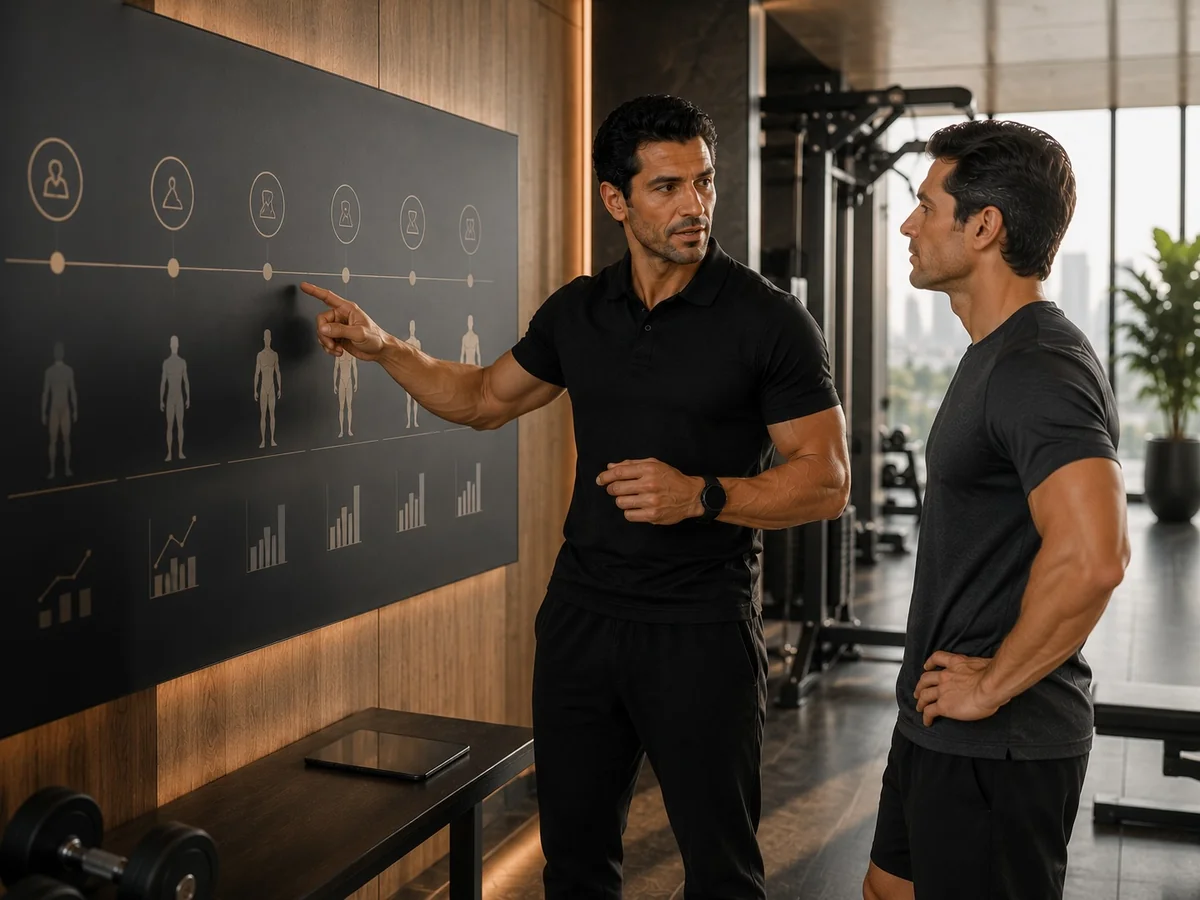
The timeline at a glance
- Weeks 2–4 — mostly neurological and behavioural: sharper coordination, more controlled weights, better sleep and energy, and the habit settling in.
- Weeks 4–12 — measurable change accumulates: fat loss becomes visible, strength climbs steadily, and the first real changes in muscle tone appear.
- Months 3–6+ — compounding: the body-composition shifts other people notice, meaningful strength milestones, and a fitter default state.
Strength and Mobility — the Early Wins
Strength is the most encouraging metric for beginners because it improves fastest. It is common to add noticeable load to the main lifts within the first four to six weeks, largely through improved technique and neural efficiency. Those early numbers are motivating precisely because they are real and rapid, and a good coach uses them to build momentum while the slower changes catch up.
Mobility and movement quality improve on a similar early timeline. Stiff hips, an achy lower back or restricted shoulders often ease within weeks once you are moving well and consistently — one of the first changes clients report, and one of the most underrated, because it makes everything else in life feel better. If you are weighing whether coaching is worthwhile at all, these early, tangible wins are part of the honest answer we set out in is a personal trainer worth it.

Fat Loss and Muscle Gain — the Slower Curves
Fat loss is where expectations most need managing. A sustainable, health-preserving rate is modest — often in the region of half a kilogram of fat per week for many people, sometimes less as you get leaner — and it is driven far more by nutrition than by the training itself. The training protects your muscle and raises the floor; the diet sets the pace. This is why two clients training identically can lose fat at very different rates.
Muscle gain is slower still, and this is not a failing — it is biology. Meaningful new muscle is built over months, not weeks, and even more gradually for women and for older trainees, though everyone can make real progress. Beginners enjoy the fastest newbie gains in their first six to twelve months; experienced trainees add muscle more slowly and have to earn every bit of it. Anyone promising rapid, dramatic muscle gain is selling a story, not a physiology.
The practical takeaway: judge fat loss over months and muscle gain over quarters and years. On those honest timelines, steady progress is not slow — it is exactly what lasting change looks like.
Why Some People See Results Faster
Ask why two people who started together are in different places by week twelve and the answer is rarely genetics, though genetics plays a part. The bigger levers are training age, consistency, nutrition, sleep and stress. A complete beginner will change faster than someone who has trained for a decade, simply because there is more low-hanging adaptation available — the same effort buys more early progress.
Everything else being equal, the person who trains consistently, eats with intent, sleeps well and manages stress will out-pace a more genetically gifted person who is inconsistent. This is genuinely good news: the fastest-moving variables are the ones within your control, not the ones you were born with. It is also a fair question to raise when you meet a coach — one of the useful questions to ask before hiring a trainer is how they will tailor the plan to your starting point.

The Multipliers — Nutrition, Sleep and Frequency
Three factors quietly decide how fast your results arrive, and none of them is the workout itself. Nutrition is the largest lever for body composition — you cannot out-train a diet that works against you, and for fat loss in particular the kitchen sets the pace while the gym protects your muscle and health. You do not need perfection, but you do need consistency and enough protein.
Sleep and recovery are where adaptation actually happens. You do not get fitter during training; you get fitter recovering from it. Chronically short sleep blunts fat loss, slows muscle repair and sabotages the next session, and is often the hidden reason a motivated person stalls. Managing stress belongs in the same category, because the body adapts best when it is not fighting on every front.
Training frequency sets the rate of stimulus. For most people two to four well-structured sessions a week is the sweet spot where progress is reliable and recovery keeps up; more is not automatically better. We work through this in detail in how often you should train — the right frequency is the one you can sustain while recovering fully.
Consistency Beats Intensity
If there is one predictor of how fast you will see results, it is not the intensity of any single session — it is how many sessions you string together without gaps. Consistency compounds; heroics do not. The client who trains three times a week for six months, unspectacularly, beats the one who trains like an athlete for three weeks and then disappears.
The common mistakes almost all trace back to broken consistency: chasing an extreme programme that cannot be sustained, changing the plan every fortnight before it has had time to work, judging progress by daily scale weight, and letting one missed week become one missed month. This is also the structure that a personal trainer versus a gym membership comparison really turns on — not the equipment, but whether the plan and the accountability keep you consistent.

Plateaus — and How to Move Through Them
Progress is never perfectly linear, and a plateau is not a sign that something is broken. Early on, almost everything works; later, the body adapts and the same plan stops producing the same results. This is expected, and it is exactly where structured coaching earns its place — a plateau is usually solved by a deliberate change in one variable (load, volume, nutrition, recovery), not by training harder at random.
The people who stall permanently are usually those without a plan to progress or a way to diagnose what has changed. A plateau is information, not a verdict — and knowing how to read it is much of what separates guided training from guesswork, a difference we explore in getting fit without a personal trainer.
How to Measure Progress — Beyond the Scale
The scale is the least informative tool you own, because it cannot tell fat from muscle from water and it moves daily for reasons that have nothing to do with progress. Better measures, used together, tell the real story: strength numbers trending up, tape-measure changes at the waist and hips, progress photos in consistent lighting every few weeks, how clothes fit, energy and sleep, and how you actually feel and move.
A good coach measures deliberately and reviews it with you, so that progress is visible even in the weeks the mirror is being stubborn. This is also how expectations stay honest: when you are tracking the right things, you can see that results are accumulating long before they announce themselves visually.

Building Results That Last
The most important timeline is the longest one. Rapid results built on an unsustainable regime tend to reverse just as quickly, which is why the crash-and-rebound cycle is so common. Results that last are built at a pace your life can absorb — training you can maintain, nutrition you can live with, and habits that survive a busy quarter and a holiday.
This is the real reason to think in months and years rather than days, and it reframes what personal training costs in Dubai as an investment in a result you keep rather than a peak you visit once. The goal is not a summit you reach and lose, but a new baseline you hold. Coaching, at its best, is less about accelerating a short sprint than about making sure the progress you build is progress you get to keep.
Frequently Asked Questions
How long does it take to see results with a personal trainer?
Most people feel changes — energy, sleep, easier movement — within two to four weeks, see measurable changes in strength and body composition between weeks four and twelve, and notice clearly visible changes from around three months onward. The exact pace depends on your starting point, consistency, nutrition and recovery.
How quickly will I lose fat with a personal trainer?
Fat loss is driven mainly by nutrition, so a sustainable rate is modest — often around half a kilogram per week for many people, sometimes less as you get leaner. Training protects muscle and supports the process, but the kitchen sets the pace. Steady loss over months is healthier and more durable than rapid drops.
How long does it take to build muscle?
Meaningful muscle is built over months, not weeks. Beginners see the fastest gains in their first six to twelve months; experienced trainees progress more slowly. Women and older trainees build muscle more gradually but make real, worthwhile progress. Anyone promising dramatic muscle gain in weeks is overselling.
Why am I not seeing results yet?
Usually one of a few reasons: you are judging too early or by the scale alone, your nutrition or sleep is undercutting the training, your consistency has gaps, or you have hit a normal plateau that needs a planned change. Results are often accumulating in measures you are not tracking.
How often should I train to see results?
For most people, two to four well-structured sessions a week is the reliable range where progress happens and recovery keeps up. More is not automatically better — the best frequency is the one you can sustain consistently while recovering fully.
Do beginners see results faster than experienced trainees?
Yes. Beginners have more available adaptation, so the same effort produces faster early progress in strength, body composition and fitness. Experienced trainees progress more slowly and have to be more deliberate — which is often when structured coaching adds the most value.
How do I measure progress if the scale is not moving?
Use several markers together: strength trending up, waist and hip measurements, progress photos in consistent lighting, how your clothes fit, and your energy, sleep and mood. These often show clear progress even when scale weight stalls, because they capture changes in muscle, fat and fitness that weight alone cannot.
The Honest Bottom Line
So, how long does it take to see results with a personal trainer? You will feel the first changes within a couple of weeks, measure real progress within a couple of months, and see the kind of change other people notice from around the three-month mark — provided the training is consistent and nutrition, sleep and recovery are working with you rather than against you.
The honest headline is that results are reliable but not instant, and that the timeline is shaped far more by consistency and the basics than by any secret in the programming. Set your expectations to months rather than days, measure the right things, and the progress will not only arrive — it will last. If you would like a realistic assessment of your own timeline and a plan built around your life, you are welcome to book a complimentary trial session and start from an honest baseline.
This article is educational and does not constitute medical or nutritional advice. Individual results vary; if you have a medical condition or are new to exercise, consult a qualified professional before starting a new programme.