If you are a busy professional over 40, the barrier to getting stronger is rarely knowledge — it is time. The good news is that you do not need four or five gym days to build real strength. Two focused full-body sessions a week, run properly, are enough to get meaningfully stronger and stay that way, and they fit around a demanding schedule far better than an ambitious plan you cannot sustain.
This is a practical guide to structuring those two days: how to choose your starting point, which movements to include, how to organise an A/B rotation, how to pick load and effort, how to progress, and what to do when a session slips. It is written with professionals in their forties and fifties in mind, and the adaptations reflect that — but the plan itself is a flexible framework to adjust to your experience and equipment, not a universal prescription.
If you want the wider picture of what training after 40 involves — the physiology, recovery and priorities — that is covered separately in our guide to strength training after 40. Here, the focus is narrower and more concrete: exactly how to make two good days a week work.
In shortTwo full-body days a week — an A/B rotation of a squat, a hinge, a push, a pull and some core or carry work — is enough to build real strength after 40. Choose a starting point that matches your experience, leave a couple of reps in reserve, progress gradually, and when a session slips, simply resume. Consistency over months beats any perfect week.
What Changes After 40 — and What Doesn’t
It helps to clear up a common worry first. Turning 40 is not a biological cliff: strength, muscle and the ability to improve are all trainable well beyond it. What actually shapes your results is a mix of factors that have little to do with the number on a birthday — how active you have been, your training experience, how well you sleep and recover, and any individual health considerations. Two people of the same age can be in completely different places.
What does tend to shift with age and a long desk-bound career is the margin for error: recovery can take a little longer, and jumping into heavy loading on rusty technique is less forgiving. That argues for a sensible on-ramp and steady progression, not for treating yourself as fragile. For the deeper physiology of training in this stage of life, see strength training after 40; the rest of this article is about the practical plan.
Start From Where You Are
The same two-day structure suits three very different starting points — and the difference is not the plan, but the load you begin with and how fast you progress. Be honest about which one describes you now, because starting in the wrong place is a common reason people stall or get discouraged.
- New to strength training — prioritise learning each movement with light, controlled sets. Your early progress comes from technique and consistency, not heavy weight.
- Returning after a break — start well below your old numbers, even if it feels easy. Your body remembers, and rebuilding over a few weeks is far safer and faster than forcing it. Our guide to returning to strength training after 40 covers the first weeks back in detail.
- Already training — you can begin closer to a genuinely challenging load and progress more deliberately, using the structure to make sure both days stay balanced.
The Movements That Matter
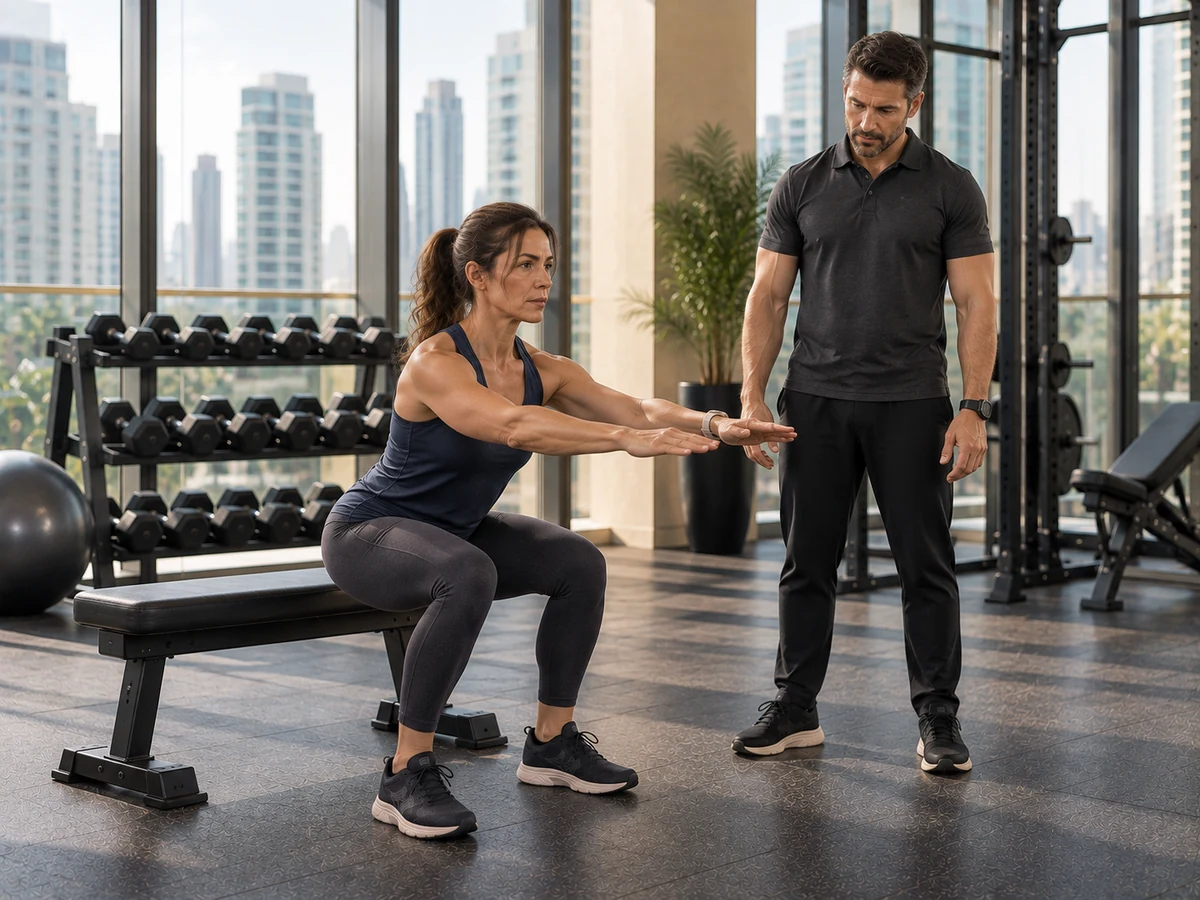
An effective full-body session is built from a small set of fundamental movement patterns rather than a long list of isolated exercises: a squat or a squat variation, a hip hinge, an upper-body push, an upper-body pull, some single-leg or single-arm work, and a little core or loaded carry when it fits. Train those patterns well and you cover almost everything that matters for everyday strength.
Crucially, the exercises are adaptable. Barbells, dumbbells, machines and cables are tools, not a ranking — a leg press, a goblet squat and a barbell squat are all valid ways to train the same pattern, and the best choice is the one you can perform well with the equipment you have. Do not let the absence of a barbell, or a preference for machines, stop you; pick the version of each pattern that lets you move with control and progress over time.

Two Full-Body Days: An A/B Structure
The simplest way to train the whole body twice a week is an A/B rotation: two slightly different full-body sessions that you alternate. Both cover the main patterns, but each leans on a different variation so the week stays balanced and does not get stale. A workable example — to adapt, not copy exactly — looks like this:
- Day A — a squat pattern, an upper-body push, an upper-body pull, and a core or carry. For example: goblet or back squat, a press, a row, and a short loaded carry.
- Day B — a hinge pattern, a different push, a different pull, and some single-leg work. For example: a Romanian deadlift or hip hinge, an incline or overhead press, a pull-down or pull-up, and split squats.
Leave at least a day between the two sessions where you can, and do not worry about which day falls on which weekday — the pattern matters more than the calendar. Training each major muscle group about twice a week this way is well supported by the research on training frequency, and it is exactly what two full-body days deliver. How many days is right for you specifically is a separate question we cover in how many days a week you should work out; this article is about how to make two of them count.
The Two-Day Plan at a Glance
Because the same structure is run differently depending on your experience, the table below shows how the starting point, technical priority, progression and recovery shift across the three profiles. Read the row that matches you now — it is an orientation, not a fixed rule.
| Profile | Starting point | Technical priority | Progression & recovery |
|---|
| New to training | Light, controlled loads; master the patterns | Consistent technique before adding weight | Add reps first; extra rest days are fine |
| Returning after a break | Well below previous bests; rebuild | Re-groove movements at moderate effort | Rebuild load over a few weeks; watch fatigue |
| Already training | Closer to a challenging load | Balance both days; refine weak patterns | Progress deliberately; protect recovery |
Choosing Load and Effort
For each working set, the goal is a weight you can lift with clean, controlled technique for the target reps while stopping a little short of failure. A useful way to gauge this is reps in reserve (RIR): finishing a set with about two reps in reserve means you feel you could have done roughly two more good repetitions. For most people, most of the time, working at around 1 to 3 reps in reserve builds strength effectively while keeping technique and recovery intact.
You do not need to take every set to absolute failure — in fact, on a two-day plan where each session carries more of the week’s work, grinding to failure repeatedly tends to cost more in fatigue than it gives back. A sensible rep range for general strength is a few sets of roughly five to twelve controlled reps per exercise; lighter, higher-rep work is also perfectly effective when the effort is real. Keep the last rep of each set clean.
How to Progress
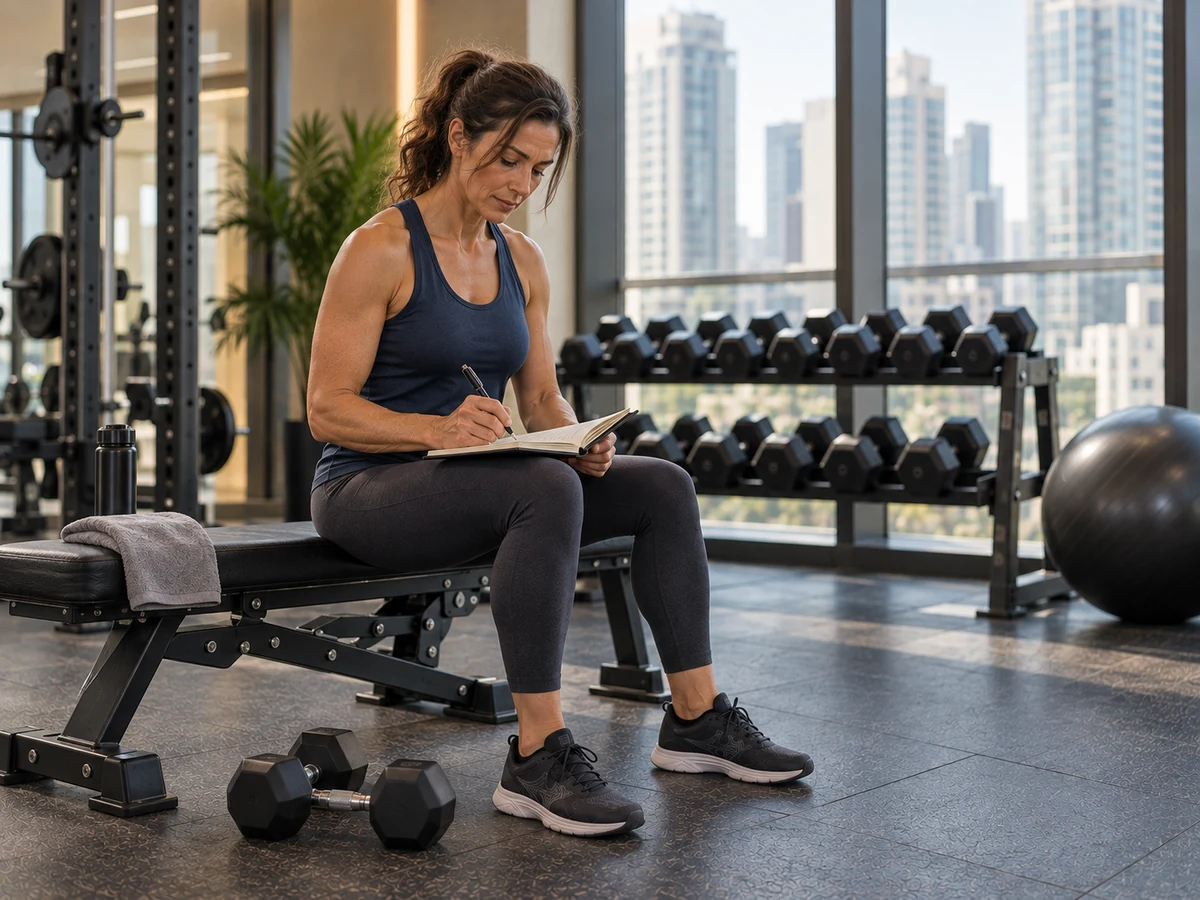
Progress on a two-day plan is deliberate and unhurried. Once a weight feels comfortable for your target reps at the right effort, make a small change: add a rep or two across your sets, add a little load, or improve the quality and range of the movement. You do not need to increase something every single session, and chasing a personal record every time is a fast route to stalled progress and niggles.
The single most useful habit is to keep a simple log — the sets, reps and load for your main lifts — so progression is based on evidence rather than feel. Judge it over weeks and months, not workout to workout; a few flat sessions are normal. If your lifts genuinely stop moving despite consistent training, the common, fixable causes are worth reviewing in why you are not getting stronger.
Recovery, Sleep and Nutrition
On a two-day plan, recovery is not an afterthought — it is part of the programme. Strength is built between sessions, so the days off are when the work pays off. Sleep is the biggest lever: general guidance places adults at around seven to nine hours a night, and routinely training at the expense of sleep tends to cost more than it returns. Keep the two training days genuinely hard and let the rest of the week support them.
Nutrition supports the process without needing to be complicated. For adults doing resistance training, research points to roughly 1.6 grams of protein per kilogram of bodyweight per day as a sensible target, with more offering little additional benefit for muscle — a general guide, not a clinical prescription, and individual needs vary. Eat enough total food to support training, spread protein across the day, and treat this as a signpost rather than a diet plan; nothing here is medical or clinical nutrition advice.

Soreness Versus Pain
Some muscle soreness in the day or two after a session — especially when you are new, returning, or trying a new exercise — is normal and not a cause for concern; it typically eases as your body adapts. It is not a required sign of a good workout, and its absence does not mean the session did not work. Mild, general soreness that settles is simply part of training.
Pain is different. Sharp, localised or joint pain, anything that changes how you move, or discomfort that persists rather than easing is a signal to stop or modify the exercise rather than push through. If pain is significant, recurring, or you have a medical condition or injury, consult a qualified healthcare professional before continuing. This article is educational and does not diagnose or treat any condition.
Training Near Home in Dubai
One of the biggest advantages for professionals in Dubai is that a two-day plan rarely requires a dedicated commute. Many residential towers have a building gym that is perfectly adequate for this kind of training, and the fundamental patterns can be run at home with a modest set of equipment. Removing the travel is often what makes two sessions a week genuinely sustainable when work is busy.
The same flexibility helps through travel and shifting weeks: the A/B structure adapts to a hotel gym or limited equipment, and the priority is simply to keep both sessions happening in some form. If protecting those two slots against an unpredictable calendar is the real challenge, the scheduling approach in how to stay fit with a busy work schedule works hand in hand with this plan.
When a Coach Helps
Most of what makes a two-day plan succeed comes down to a few judgement calls — choosing the right starting load, keeping technique clean as weights rise, selecting the best exercise variations for your body and equipment, and adjusting the programme as you progress. Those are exactly where a good coach adds value, particularly in the first weeks or when returning after a long break. In-person personal training in Dubai gives you hands-on technique work; online performance coaching provides structure and accountability remotely; and a hybrid arrangement blends the two for people whose weeks move around.
None of this means a coach is mandatory — plenty of people run a two-day plan well on their own. But if you want to be sure your starting point and technique are right, or you have stalled, an experienced eye shortens the trial and error. What a coach cannot do is guarantee a timeline; what they can do is help you get the important decisions right sooner.

Your First Week
If you are starting from scratch, keep the first week deliberately simple — the goal is to begin and repeat, not to impress yourself:
- Pick your two days — choose two slots you can realistically protect, ideally with a day between them.
- Choose your movements — one exercise for each pattern (squat, hinge, push, pull, plus core or carry), using the equipment you have.
- Start light — use loads you can control for the target reps with reps in reserve; leave your ego out of week one.
- Write it down — log the sets, reps and load so you have a baseline to progress from.
- Repeat and adjust — run both sessions again the following week, adding a little only when the current load feels controlled.
That is the entire on-ramp. No seven-day transformation, no complicated split — just two sessions, repeated and gradually progressed. The results come from doing it for months, not from any single week.
Frequently Asked Questions
Can two days a week really build strength?
Yes. The evidence on training frequency shows that what matters most is training each major muscle group at least a couple of times a week with enough quality effort — and two full-body sessions do exactly that, covering the whole body twice. More days can help some people, but they bring diminishing returns and are not required to get meaningfully stronger. Two well-run sessions you actually keep will beat an ambitious four-day plan you abandon.
Is two days a week enough after 40?
For most people, yes. Age itself is not the barrier that popular fitness culture suggests; inactivity, poor recovery and inconsistency matter far more than a birthday. An adult in their forties or fifties who trains two focused full-body days, progresses sensibly and recovers well can build real strength. What tends to change with age and training history is how quickly you add load and how much recovery you need — not whether the approach works. The broader picture of training after 40 is covered in our piece on strength training after 40.
How long should each session take?
A focused full-body session usually fits comfortably into about 45 to 60 minutes, including a brief warm-up. The aim is quality, not duration: a handful of well-chosen movements taken through controlled, challenging sets does more than an hour of unfocused exercises. If time is very short, a shorter version of the same session is far better than skipping it.
What if I miss one of the two days?
Do not try to cram both sessions into one day or punish yourself with extra volume. Simply run the next session you can and carry on — over a month, consistency matters more than any single workout. If your week is routinely unpredictable, the habit-level fixes in our guide to staying fit with a busy work schedule pair well with this plan.
Should beginners, returners and trained people all follow the same plan?
The same two-day structure works for all three, but the starting load and the rate of progression differ. A beginner prioritises learning the movements with light, controlled sets; someone returning after a break starts well below their old numbers and rebuilds; an experienced trainee can start closer to a challenging load and progress more deliberately. The plan is a framework to adapt, not a fixed prescription.
Do I need a barbell or a full gym?
No. Barbells, dumbbells, machines and cables are tools, not a hierarchy — each fundamental movement can be trained with whatever you have. A typical residential building gym in Dubai, or a modest home setup, is enough to run this plan well when the exercises are chosen around the equipment available.
How do I know I am actually progressing?
Keep a simple log of your main lifts — the sets, reps and load — and look for a gradual upward trend over weeks, not records every session. Progress can be a rep added, a small load increase, or cleaner technique at the same weight. Judging by feel alone is why many people cannot tell whether they are improving; the reasons strength stalls are covered in why you are not getting stronger.
Should I train to failure on every set?
No. For most people, leaving a small margin — a couple of reps in reserve (RIR), meaning you could have done about two more good reps — drives strength while keeping technique clean and recovery manageable. Occasional harder sets are fine, but grinding every set to absolute failure tends to cost more in fatigue than it returns, especially on a two-day plan where each session matters.
The Bottom Line
Getting stronger after 40 does not require living in the gym. Two focused full-body days a week — an adaptable A/B rotation of the fundamental patterns, run at a sensible effort and progressed gradually — is enough to build real strength and sustain it around a demanding professional life. Start from where you actually are, leave a little in reserve, keep a simple log, and when a session slips, just resume. Do that consistently and the two days quietly compound into results. For a fuller way to judge those results than the log alone, our guide to tracking fitness progress beyond the number on the scale shows which other indicators are worth watching.
If you would like help setting your starting point, checking your technique, or building a two-day plan around your schedule and equipment, that is exactly what considered coaching provides. You are welcome to book a complimentary trial session, and we can build the right version of this for you.
This article is educational and does not constitute medical or nutritional advice. Individual needs and responses vary; if you have a medical condition, an injury or persistent pain, consult a qualified professional before beginning or changing a training or nutrition programme.